

Species Spotlight: White-Tailed Kite Hovers above MSHCP Lands
Look! Up in the sky! It’s a plane! It’s Superman! Actually, it’s a White-tailed Kite (Elanus leucurus). Just like superheroes on the big screen, this bird species made a comeback after almost going extinct from hunting and egg-collecting in the early 1930s.
The White-tailed Kite is a small to medium-sized raptor, recognized by its pale gray and white plumage, bold black shoulders, red eyes, and pointed wings. Its wingspan to the tips of its narrow, pointed wings reaches about 43 inches.
As their name suggests, White-tailed Kites have a super-bird behavior – appearing to hover like a kite by facing the wind and flapping their wings. This allows them to stay stationary as they scan the ground for delicious prey, a behavior known as “kiting,” not an easy skill to wing. Kites achieve this effect by flying into the oncoming headwind at just the right speed to counteract their forward movement.
White-tailed Kites are year-round residents throughout much of California, from the coastal areas to the arid regions of southern California, including western Riverside County. Within the MSHCP Conservation Area they have been observed “kiting” around the Prado Basin/Santa Ana River, Lake Mathews-Estelle Mountain, Wasson Canyon, Vail Lake, Wilson Valley, Lake Skinner/Diamond Valley Lake, and Lake Perris/Mystic Lake areas. Although the species recovered historically, numbers have been declining in recent years within MSHCP conserved lands and western Riverside County as a whole. Excitingly, successful nesting was documented in 2023 on MSHCP conserved land near San Timoteo Canyon.
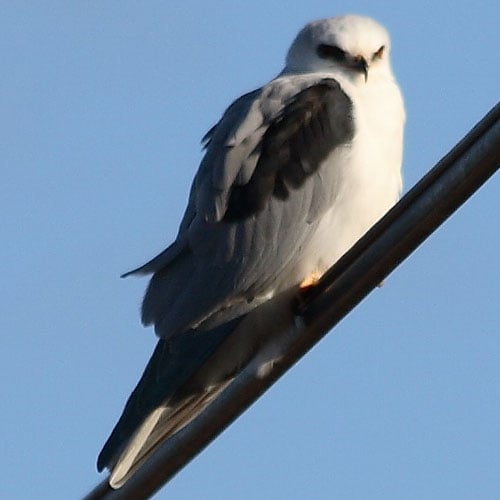
White-tailed Kites hunt over open landscapes with low and sparse vegetation, including grasslands, open-canopy chaparral, coastal sage scrub, and marshlands. Their diet is varied and primarily consists of small mammals, but also includes small birds, snakes, lizards, frogs, and insects. Once they spot prey, they swiftly drop down to capture their unsuspecting target.
For nesting, they select prominent trees along the edges of riparian, woodland, and forest habitats, locations that provide safety to raise young from vantage points with good visibility and access to food.
Courtship and nest building often begin in early winter, with egg laying begging in early spring. Females lay three to five eggs that hatch in approximately 30 days. Young fledge approximately four to five weeks later but remain dependent on their parents for up to three more months. During that time, they are learning skills from their parents such as hunting and other survival skills. If conditions are favorable, pairs may attempt a second brood within the same season.
White-tailed kites face ongoing pressure from habitat loss due to urban development, habitat degradation (including invasive species), agriculture practices that reduce prey abundance, and pesticide use that affect prey populations. Through the MSHCP, at least 19,880 acres of suitable breeding habitat and 281,890 acres of foraging habitat are conserved for the White-tailed Kite.